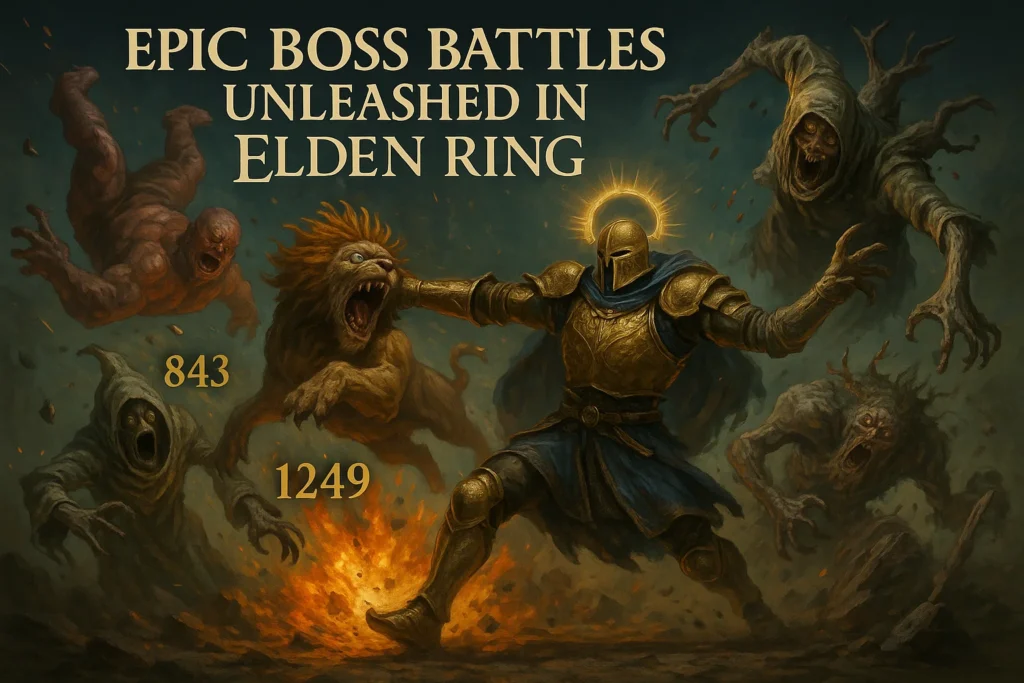
When you’ve played enough Elden Ring, you start to think you’ve seen every weird interaction this game can throw at you. Then someone mod-tests Roralux against every major boss with fully functional grabs, and suddenly the entire world turns into a physics carnival. The video behind this breakdown doesn’t just show a regular boss rush—it shows what happens when a moveset designed to ragdoll enemies finally stops being restricted and goes absolutely feral. As someone who’s spent a lot of time poking around Elden Ring’s hitboxes and boss logic, I can say this: these fights reveal way more about the game’s design than just slapstick chaos.
How Grabs Change Everything
Most players only understand grabs as high-risk, high-reward attacks, but with Roralux they become something else entirely. Once enabled, the grabs don’t just stagger bosses—they distort them, swing them around, send them flying, and sometimes snap their animations in half. Half the video is a parade of broken bones, twisted limbs, and demigods being lifted like cardboard cutouts.
In some ways, the grabs highlight how dependent Elden Ring’s bosses are on stable posture values. When Roralux connects, enemies lose every bit of internal structure the engine assigns them. It’s funny, sure, but it also shows why the developers disable these animations for boss-scale enemies. At full strength, they’d trivialize half the game. And honestly, if you’ve ever been tempted to buy elden ring runes to speed up early leveling, watching this level of destruction might make you rethink how much power you really want to unlock at once.
Scaling Matters More Than People Think
Halfway through the video, the creator switches to equal scaling—Roralux and the boss matching stats—and the whole tempo changes. Suddenly damage values make sense again, grab frequency shifts, and each encounter becomes a little more readable. But readable doesn’t mean normal.
Even at equal scaling, Roralux’s kit is built around massive posture breaks and explosive finishers. Against enemies like Godfrey or Morgott, you can see just how vulnerable they become once their posture dips even slightly. The fights feel less like duels and more like fragile engineering tests the engine isn’t prepared to pass.
This is actually where the mod shines for players interested in combat behavior. You start noticing details that you’d normally overlook in a regular playthrough: how bosses trigger recovery animations, how they reset posture, and how much environmental overlap affects their physics. These insights are incredibly useful if you enjoy experimenting with off-meta builds or testing weird interactions.
When Bosses Fight Back
Not everything goes Roralux’s way, though. A surprising highlight is his matchup against Rykard (or “Ricardo,” as the creator jokes). For some reason, Rykard becomes a brick wall. His lava chip damage adds up constantly, his grab attempt actually works on Roralux, and his massive body reduces how effective some throws are. At one point, Roralux even loses outright, which is hilarious considering he ragdolls almost every other boss on the list.
Watching these fights reminded me of how unpredictable Elden Ring can be behind the scenes. Even if you try to buy elden ring runes safe to push your build forward, power doesn’t always translate cleanly when bosses have unusual hitboxes or terrain advantages. With Rykard, the matchup looks less like a joke mod and more like a real endurance test. It’s one of the rare moments where the engine’s quirks actually favor the boss.
The Chaos Peaks with Malenia
Of course, nothing compares to Malenia. Every player knows she’s the final exam of Elden Ring—fast, aggressive, and built to punish any tiny mistake. But here? She turns into an unhinged ragdoll puppet the moment a grab connects. Her head pops off, her limbs twist into impossible shapes, she phases through the ground, and sometimes she simply disappears until the engine remembers where she’s supposed to be.
It’s weirdly cathartic to watch Malenia—the boss who has bullied millions of players—get treated like a piece of scrap cloth. But the fight also shows how thin the line is between “intended difficulty” and “engine meltdown.” Her second phase becomes especially unstable: if Roralux grabs her during Scarlet Aeonia, the game practically gives up trying to track her animation states.
If anything, this part of the video is a reminder of how flexible—and unstable—the game’s core systems can be. Anyone who’s spent hours perfecting dodge timings or optimizing bleed builds will appreciate just how much hidden calculation goes into keeping these fights consistent.
Why These Fights Matter for Players
Even though the entire showcase is comedic, it has surprising educational value. You see how scaling changes fight dynamics, how posture truly controls the flow of battle, and how bosses rely on rigid animation states to stay threatening. These observations can help you fine-tune your own builds and better understand why certain weapons or Ashes of War feel stronger than expected.
Another nice detail is how the video highlights “engine edge cases”—moments where enemies lose invulnerability frames, fail to recover posture, or get stuck during transitional animations. For players who enjoy experimenting or speedrunning, these insights can be super valuable. They hint at which encounters are more vulnerable to stagger or interruption, and which enemies resist manipulation due to size or terrain.
This mod showcase isn’t just funny—it’s a fantastic window into Elden Ring’s design. Watching Roralux tear through demigods like they’re made of paper reveals just how carefully tuned the original game truly is. Without the usual restrictions, the boss system becomes a chaotic physics experiment full of collapses, glitches, and unanswered questions. And honestly, that’s part of the charm.
If you’re the type of player who enjoys exploring the game beyond its intended limits, or someone who studies how bosses behave under stress, this video is absolutely worth checking out. It’s messy, unpredictable, and surprisingly informative.
Summary
Roralux’s grab-enabled boss run shows how much Elden Ring relies on posture, scaling, and stable animations to maintain difficulty. Some bosses crumble instantly, others resist through terrain or chip-damage advantages, and a few—like Malenia and Rykard—create fascinating edge cases. Beyond the humor, the fights reveal subtle combat mechanics that can help players understand the game more deeply.