Forza Horizon 6 leans hard into what the Horizon series has always done best: contrast. One moment you’re in hypercars; the next, you’re stuck in bone-stock microcars crawling through a 53-mile endurance event where real life interruptions become part of the meta.
This particular community-run “Goliath-style” race showcases FH6 at its most chaotic: ultra-slow Peel P50 drag races, marathon-length circuits, and players multitasking with Uber Eats, chess games, and even real-world dog walks mid-race.
It’s not just a race. It’s a test of patience, bandwidth, and finger endurance.
The Peel P50 Experiment: When “Fastest Car Video” Goes Wrong
The session begins with a deliberate constraint: instead of high-end builds, players revert to the infamous Peel P50—one of the slowest vehicles in Horizon history.
Peel P50 Baseline Performance (Stock Setup)
| Metric | Value |
| Top Speed | ~37 mph (downhill optimism included) |
| 0–60 mph | “Eventually” |
| Handling | Stable only if nothing happens |
| Upgrade Dependency | None (it cannot be saved) |
| Race Viability | Psychological endurance only |
The group initially attempts a drag race, producing a hilariously tight result:
- Quarter-mile equivalent: ~36 seconds range
- Speed differences: effectively negligible
- Outcome factor: whoever didn’t crash or mis-shift wins
Even basic mechanics like traction control off vs on become philosophical debates rather than performance optimizations.
The Main Event: Goliath 53-Mile Endurance Chaos
The centerpiece is FH6’s massive Goliath-style circuit—over 53 miles of mixed terrain, elevation, and long alpine climbs.
Race Structure Overview
| Segment | Distance Contribution | Difficulty |
| Urban Japan Roads | ~15% | Low speed, high chaos |
| Coastal Highway | ~20% | Constant drafting battles |
| Mountain Ascent | ~35% | Severe speed loss |
| Snow Transition Zone | ~15% | Grip reduction + visibility |
| Final Descent to Finish | ~15% | High tension, checkpoint pressure |
Key observation: the race becomes less about speed and more about gear selection psychology.
Gear Strategy Meta (Yes, That Became a Thing)
Players oscillate between automatic, manual, and “leave it in second and pray” strategies.
Observed Gear Behavior Outcomes
| Strategy | Result |
| Constant shifting | Faster bursts, higher crash rate |
| Staying in 2nd gear | Stable uphill torque, lower top speed |
| 3rd gear cruising | Balanced but inconsistent uphill performance |
| Automatic | Surprisingly competitive in chaos segments |
| No shifting (limiter bounce) | Meme strategy, sometimes works |
One consistent truth emerges: FH6 rewards stability more than precision in ultra-low horsepower scenarios.
Real-Life Interruptions Become Gameplay Mechanics
Unusually, the race integrates external life events:
- Uber Eats deliveries arrive mid-race
- Players pause mentally for snacks and drinks
- One driver is temporarily disconnected by an internet outage
- Controller fatigue leads to tape-and-rubber-band “accessibility mods”
- A driver swap occurs mid-race (treated like a pit stop in endurance racing)
“IRL Pit Stop Impact Table”
| Event | Time Loss | Competitive Impact |
| Uber Eats order | 5–15 min mental distraction | Medium |
| Dog walk break | 10–30 min AFK risk | High |
| Internet disconnect | Full race interruption | Critical |
| Controller swap | 1–2 min recovery | Low |
| Chess/GeoGuessr multitasking | Cognitive degradation | Unmeasurable |
The race effectively evolves into a hybrid simulation of racing, endurance streaming, and survival multitasking.
The 53-Mile Psychological Breakdown
By the halfway point, the race stops being about driving skill and becomes endurance arithmetic.
Progression Model
If the group maintains ~1% progress per minute:
| Race Progress | Estimated Time |
| 25% | ~25 minutes |
| 50% | ~50–60 minutes |
| 75% | ~75–85 minutes |
| 100% | ~90–100+ minutes |
At scale, this transforms FH6 into something closer to a marathon simulator than a racing game.
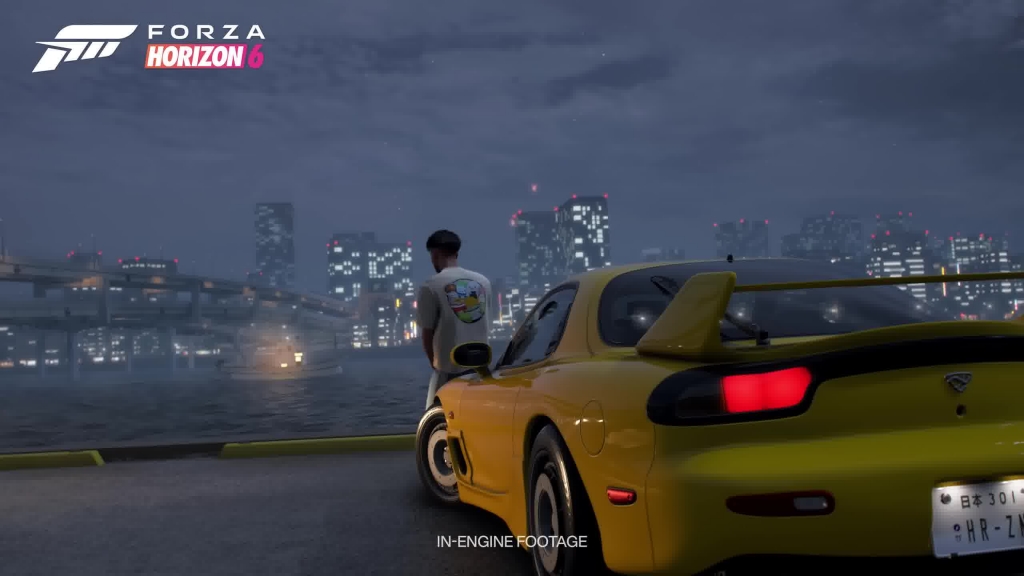
Environmental Highlights: Japan‘s “Unfairly Pretty” Map Design
Players repeatedly note environmental distractions:
- Cherry blossoms rendering in motion blur trails
- Bullet trains passing alongside mountain roads
- Dense Tokyo-style elevation layering
- Snow transition zones appearing mid-season inconsistently
- Mirror and rear-view reflections used as comedic visual gags
The visual fidelity actively competes with gameplay focus—often winning.
Reward Structure: Credits vs Reality
Despite completing a massive endurance event, reward expectations remain unclear. Community speculation centers around progression scaling tied to time and completion.
Estimated Reward Scaling Model
| Completion Time | Expected Reward Tier |
| <30 min | Low credits, casual payout |
| 30–60 min | Standard event reward |
| 60–90 min | High endurance bonus |
| 90+ min | Potential “legendary” scaling event |
This is where monetization discussion naturally enters the community conversation, particularly around progression pacing and grind efficiency.
Some players reference external acceleration options such as FH6 Credits and discussions around whether systems like progression boosts-style convenience models would even make sense in a marathon-heavy sandbox environment like this.
Others go further into car acquisition optimization debates, including whether Buy Forza Horizon 6 Cars approaches would fundamentally alter endurance-style gameplay balance.
Key Takeaway: FH6 Turns Racing Into Social Engineering
What this session ultimately demonstrates is not speed or skill—but coordination under absurd constraints.
- Slowest car possible
- Longest practical race format
- Real-world interruptions integrated naturally
- Strategy devolving into improvisation
- Comedy emerging from failure states
Forza Horizon 6 succeeds here not because it is balanced, but because it allows chaos to become the main mechanic.
And in that sense, the Peel P50 Goliath isn’t a race.
It’s a structured breakdown of human attention over 90 minutes.