An Act 5 boss has barely enough time to move before a Duelist’s sword combo ends the fight. Another encounter looks nothing like it: the Duelist plants a banner, starts spinning, and tears through enemies without stopping to line up a finishing blow. Those two fights make a better case for swords in Path of Exile 2 than a single damage number. Worldcutter rewards a well-timed opening; Cyclone rewards knowing where to fight. Both are campaign examples from a preview build, not promises about endgame bosses when version 1.0 launches on December 11, 2026.
Sword Damage
Worldcutter is a channelled, two-handed sword strike. Each stage of the channel adds damage and widens the eventual cleave. Pair it with Echoing Strikes and afterimages repeat the attack. That distinction matters when a boss appears to die in one hit: the player releases the sword once, but the target takes a sequence of strikes. The real decision comes before the swing. Release early to catch a boss before it moves, or hold for a heavier blow and risk missing the opening.
Cyclone gets its damage a different way. The Knight’s Vaal Standard covers the ground in blood, which Cyclone draws into the spin to send out blood waves. The banner isn’t a passive bonus that follows the Duelist everywhere. Placement sets up the attack. Against a boss that stays put, the Duelist can keep spinning through the same patch; against one that repeatedly crosses the arena, choosing when to plant matters as much as the sword itself.
Duelist: Knight
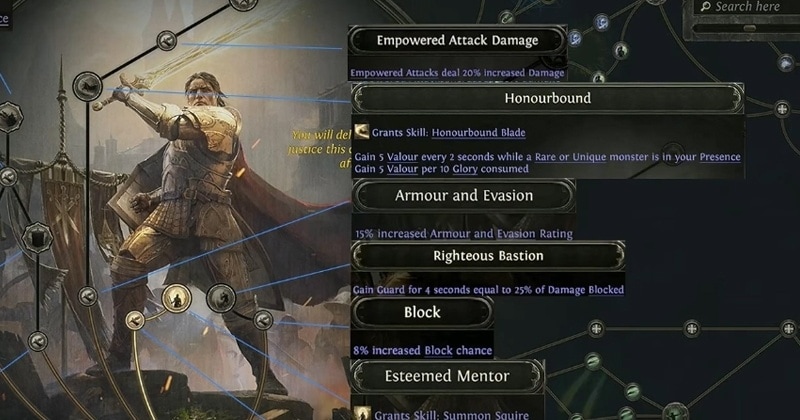
The Knight has a particularly readable Ascendancy choice. One option grants 15% more damage in the presence of a qualifying Rare or Unique enemy and 15% less damage taken while surrounded. The other reverses those benefits: more damage in a crowd, less damage taken against the Rare or Unique threat. A player who clears packs comfortably but struggles to finish bosses has a reason to take the first. A player who already hits hard enough but dies during boss attacks has a reason to take the second.
Summon Squire gives the Knight a different way to build. The Squire can wear a helmet, body armour, gloves, and boots, and its weapon helps determine which combat skills it can use. There are no ring slots, so planning around a pair of Unique rings is a dead end. A better starting question is what job the companion should perform while the Duelist attacks. A Squire that sets up a follow-up hit has a purpose even if its own damage is modest. For players who prefer to make the opening themselves, Liberator’s Chariot offers a mounted charge that scatters and stuns enemies.
Master-at-Arms
The Duelist’s second Ascendancy, Master-at-Arms, has prompted one obvious question: how many of those weapons can the character actually use in a fight? The artwork shows swords alongside a bow, spear, daggers, and crossbow. It sells the idea of a fighter trained in several disciplines, but it doesn’t establish extra weapon slots, automatic swaps, or bonuses for alternating attacks. That leaves a practical distinction for anyone planning a launch build: Knight players can already map out a Vaal Standard and Cyclone interaction; Master-at-Arms players still need the passive wording before committing to a multi-weapon setup.
Shadow: Daggers and Traps
The Shadow’s most interesting early dagger skill is Viper Strike, a Tier 1 option that gives poison builds something to do from the start. Using it from Stealth coats the weapon in poison, setting up toxic explosions on follow-up hits. Shroud fits naturally into that sequence: the Shadow dashes, enters Stealth, and leaves a Shade at the old position. The retreat is also preparation for the next attack.
Traps give the Shadow a reason to think about attack order. Shrapnel Trap can Impale the target before a Viper Strike ambush, so those impales contribute to the poison sequence. A dedicated trap setup takes a different approach: lay Poison Gas Trap, Concussive Trap, and Fire Trap in sequence before detonation to spread the blast across a wider area. These are firmer foundations for a build than assumptions about the Shadow’s two Ascendancies. Assassin and Infiltrator are their names; the names alone don’t establish critical-strike bonuses or a particular trap-trigger mechanic.
New Uniques
Agnar, a Unique Vampiric Longsword, adds cold damage as the wielder gains levels. Its signature skill, Fangs of Agnar, explains the distinctive V-shaped attack: two swings raise walls of ice crystals, then a downward slam shatters them. Elysium, a one-handed Sickle Sword, grants Siege of Sands. Channel to gather sand, dash through the target, and Sand Mirages follow with slashes of their own. The longer channel produces more mirages. For players searching “buy POE2 Currency” while pricing upgrades, there’s a useful distinction here: compare these swords by the skill the build needs, not just the physical damage printed on the weapon.
Minion players also have two sharply different Uniques to consider. Siegebreaker gives minions more maximum life and regeneration, and casting its granted skill, Bunkerbuster, shortens their revival timer. The Watcher in the Dark takes the opposite approach: the staff boosts minion damage and causes minions to explode on death, dealing physical damage based on their maximum life. One item helps keep a minion fighting; the other gives its death an offensive purpose.